

Information reviewed: October 2, 2026
Information reviewed: October 2, 2026. Recheck the official links and speak with the relevant program team or participating distributor for the actual project before relying on eligibility or funding. Keep their answer with the decision record, including the equipment and commitment status it addresses.
Oakville’s employment-area review includes land around Highway 403.
For a premises in that area, identify the building and occupied unit as well as the included office, storage or customer-facing spaces. Separate a tenant’s equipment proposal from common-building work and note who can authorise each boundary. An Ontario program enquiry still needs the actual Oakville location and the facility contact, rather than a company name covering several unrelated sites.
Keep the reason for the improvement understandable without a funding outcome. A business may need a clearer working arrangement, a planned equipment change or more useful operating choices. The incentive discussion should inform that decision without concealing an unresolved facility requirement.
Keep each proposed product with its location
Prepare a small equipment packet that can be followed by someone outside the facility. Associate the product under discussion with its room, quantity and intended task. Keep a current candidate separate from an earlier quotation or an alternative still being compared. The program contact should be able to tell which option the question concerns.
Mark how the existing-condition information was obtained. An equipment schedule, invoice or ordinary-view photograph can describe different parts of the record. State where model details are unconfirmed and where a drawing no longer matches the occupied layout. Ask what additional evidence is needed for the selected route rather than inventing details to fill the gap.
Use dated versions when the option changes. A revised product, quantity or included area should remain traceable to the corresponding question and response. Closed fixtures and anonymous inventory notes illustrate that preparation context; a generic photograph cannot demonstrate eligibility for a particular purchase.

Distinguish four project states
| Current state | Record to retain | Question to resolve |
|---|---|---|
| Exploring an option | Keep the facility purpose, alternative equipment and unresolved scope together. Note which quantities and product details are provisional. | Which official route should review this particular proposal, and what information is needed first? |
| A quotation exists | Retain the dated option and identify whether it includes supply, installation, controls and related work. A quotation alone should not be described as a completed purchase. | What change would turn this discussion into a commitment, and who can authorise that action? |
| An order or agreement exists | Provide the actual document and status to the relevant contact. Distinguish an issued order, an unsigned draft and a signed agreement accurately. | How does the current commitment status affect the route being considered? |
| Work has begun | Describe the areas and work already started, with the records available. Keep completed and remaining portions identifiable. | What can the program team confirm for the actual sequence, rather than an assumed future project? |
Read the current route before adopting its process
Instant Discounts offers eligible existing-building lighting purchases through participating distributors in Ontario. New-construction lighting is excluded. Standard controls are included, while networked lighting controls remain on a separate Retrofit route.
The Instant Discounts requirements distinguish the distributor incentive from the customer’s pass-through discount. Customer contribution, eligible products, invoice treatment and installation timing need confirmation for the purchase.
Retrofit requires a submitted application and accepted participant agreement before a binding commitment, including an equipment order or signed service contract. Work started after submission but before pre-approval carries a risk of reduced funding or rejection.
The current Retrofit prescriptive table includes networked lighting controls, refrigerated display-case LED fixtures and specialist horticultural lighting and controls. Confirm the exact current measure for the proposed work.
Small Business follows a direct-install route through qualified Save on Energy contractors. Participants review proposed upgrades and the work order, and sign the participant agreement before installation. Previous participation needs review by the program team.
The Small Business requirements assess employee capacity on site at the facility under full operation, rather than total company headcount. Prior participation can affect measure and cost-cap review; confirm the actual history with the program team.
Treat these official distinctions as questions for the exact facility and measure. Identify who will confirm the route and keep that answer separate from a general equipment recommendation. A program delivery arrangement should not be assumed to describe your chosen contractor, supplier or the work included in an unrelated proposal.
Where more than one route seems relevant, ask the program contacts how the proposed measures and prior support should be reviewed. Provide the actual equipment and purchasing record. Resolve the relationship through the official process before relying on support, rather than assembling a funding expectation from several category labels.
Describe the operating purpose behind controls
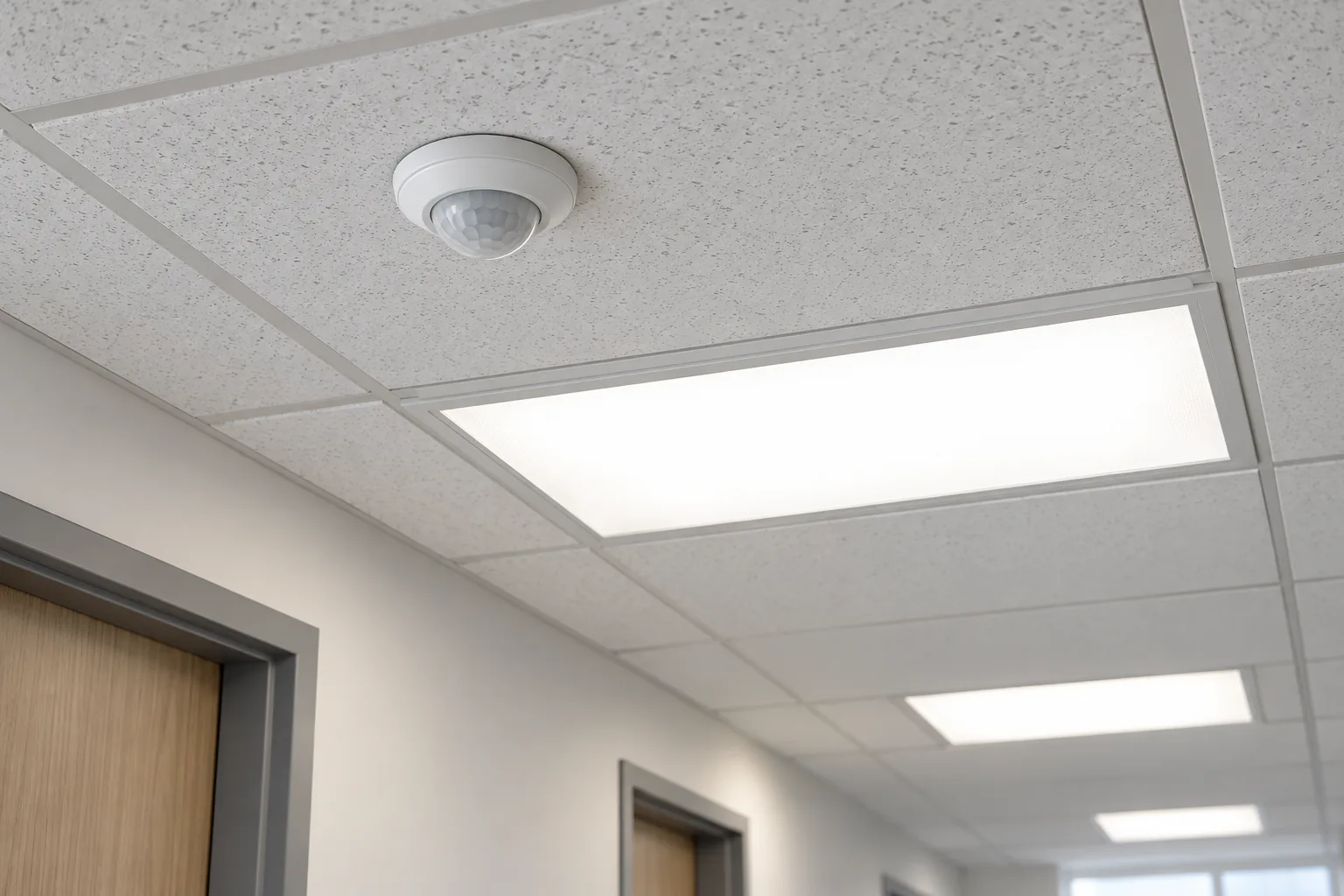
A ceiling sensor beside a fixture shows a physical arrangement, not a confirmed program category or a connected-system capability. Write the operating purpose in ordinary facility terms: the spaces used together, the tasks continuing during quieter periods and the people responsible for room choices.
Keep the proposed controls boundary with the retained equipment record. Ask which devices, fixtures and interfaces are included in the option and what documentation will confirm their suitability. The program question should refer to that defined option rather than an isolated sensor or a generic connected-product description.
If central coordination is being considered, name the people who would approve and manage it. A facilities contact, purchasing team and IT contact can have different decisions to make. Define the requested function and ownership before treating additional features as part of the funded or approved scope.
Three confirmations belong in the decision record
Facility authority
Identify the person entitled to approve the included tenant or property work. Record any landlord, shared-area or project dependency still open. A business need and a useful quotation do not resolve who can commit the facility to the defined scope.
Equipment and work
Confirm the selected option, retained equipment and actual supply or installation boundary. Make exclusions, access and substitutions visible. Keep the record specific enough that the purchasing decision and the practical project discussion refer to the same proposal.
Program position
Retain the current response from the relevant official contact and the facts on which it was based. Identify remaining conditions and follow-up responsibilities. A favourable discussion should remain distinguishable from the confirmation needed for the particular project and sequence.
Build the enquiry in four manageable steps
-
Define the facility question
Name the property, included areas and improvement being considered. Separate the business purpose from the potential support. Identify the equipment option and any retained or shared boundaries that could change the proposed work.
-
Assemble the current record
Gather available existing-condition information, the dated equipment option and commitment documents. Mark estimates and missing records openly. Give each site its own location reference if the business is discussing several premises.
-
Ask the official contact
Introduce the actual option and status to the relevant program team or distributor. Ask which eligibility, evidence and sequence questions need resolution. Keep the answer attached to the proposal it concerns and name the person following up.
-
Align the project decision
Review the confirmed position with purchasing and the scope approver. Make changes to products, areas or timing visible before the next action. Record unresolved conditions rather than letting a possible incentive silently become an approved budget assumption.
Assign a contact to each unanswered question
An incentive discussion can stall because the right information is held by different people. The property manager may know the previous installation, purchasing may hold the order and the operating contact may know the room’s future use. Put a named follow-up owner beside each gap so the next conversation does not repeat an incomplete brief.
Keep confidential business, financial and account information within the organisation’s approved sharing arrangements. An opening service enquiry can identify the relevant contact and document type without including passwords or unrelated private records. Ask the program contact what information is needed through its actual submission process.
For a phased project, explain what is ready for decision and what remains provisional. A later room or building may have different equipment, authority or timing. Preserve a separate site record where needed, and ask how changes should be handled before assuming an earlier response covers every remaining phase.

Keep the evidence aligned with procurement
If the preferred product becomes unavailable, do not let the substitution disappear into purchasing administration. Record the new candidate and ask the relevant project and program contacts what needs another review. The same process applies when quantities, areas or the intended operation change.
When a purchase or work decision has already occurred, describe it accurately and obtain the current program position for that sequence. Keep possible support separate from confirmed project commitments while the question is resolved. A clear account of what happened is more useful than presenting the remaining work as if the entire project were still at its starting point.