
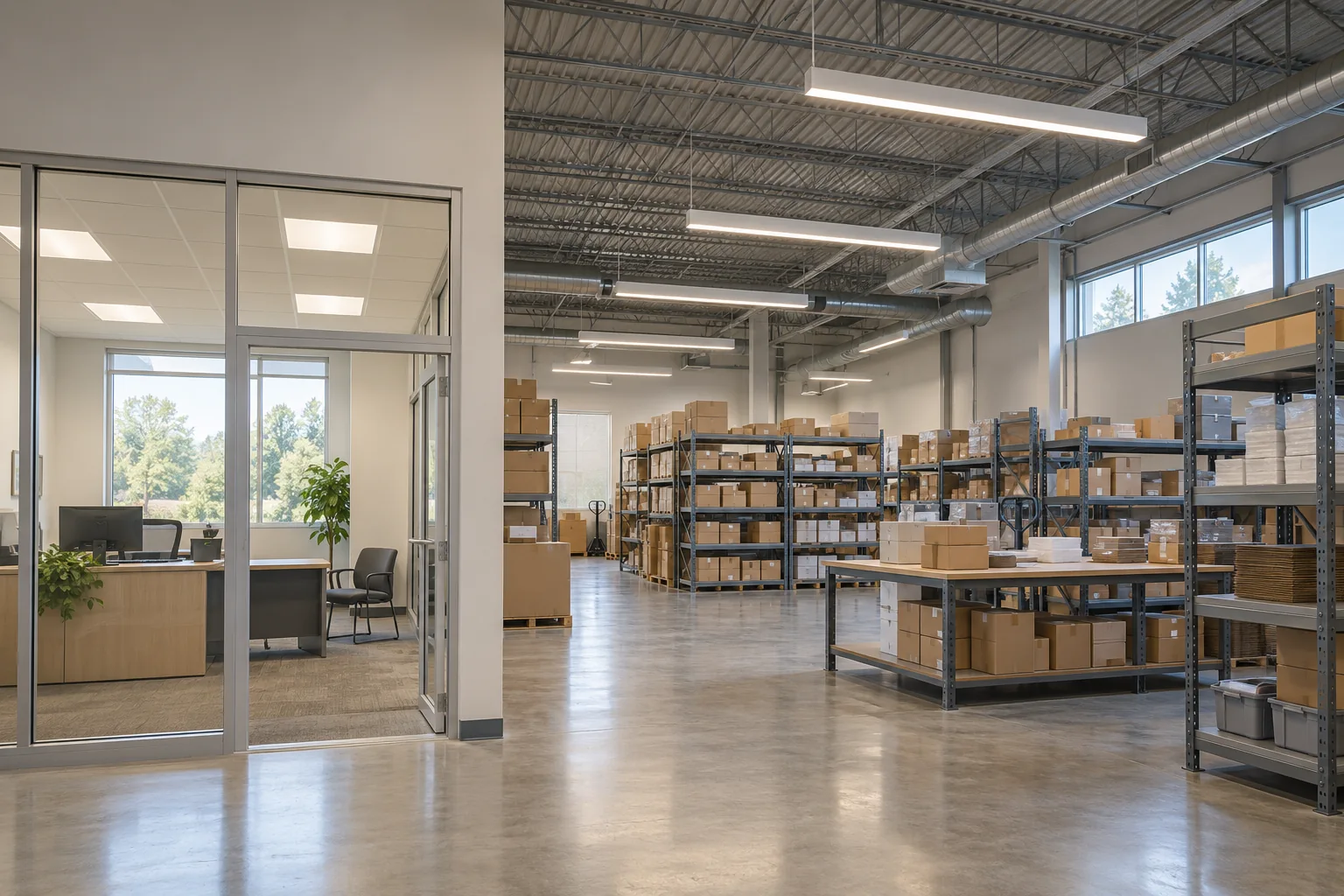
Write the replacement boundary before the product list
Define what the business is deciding now. Replacing a repeated fixture family, redesigning an area after racks move and addressing one present fault should not share an undefined project boundary. A useful opening statement names the areas under review, the intended outcome and the equipment expected to remain.
Oakville’s Employment Areas Review identifies offices, factories and warehouses.
Use that mixed-facility context to separate the actual work at your premises. An Oakville unit may combine front offices, storage and a loading interface, each with a different approval or operating contact. State the unit and shared-property boundaries before a ceiling count becomes a purchase quantity.
Mark proposed future changes as proposed. If the racking plan, lease area or office arrangement is unresolved, the lighting option may depend on a decision outside the replacement project. Naming that dependency early lets the team compare a ready area with one that needs further planning.
Separate confirmed equipment from useful estimates
Create an inventory whose information can be traced. A confirmed model from a current equipment schedule carries a different status from a description made from the floor. Keep each item’s source beside it: current record, earlier service document, ordinary visual description or quantity still to be checked. The aim is to make uncertainty manageable before procurement.
Use area references that will survive later revisions. A room name or rack-zone reference can connect equipment information with access, purchasing and the intended activity. If products have been replaced individually over time, show that history rather than assuming the first identified fitting represents the whole group.
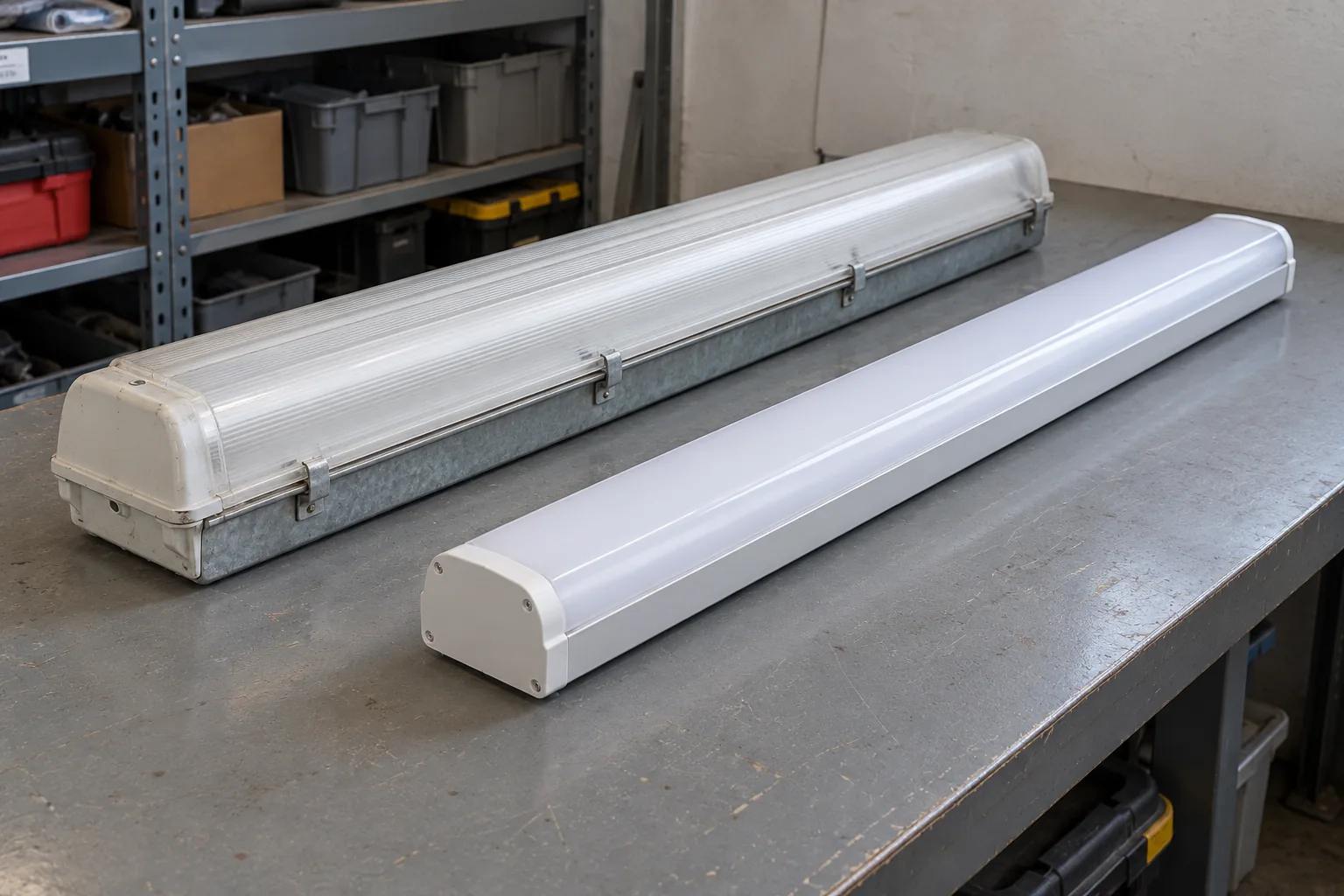
Closed fluorescent and LED examples can illustrate different external forms, but the installed arrangement needs its own review. Ask which equipment details must be verified for each option and who will provide that confirmation. People preparing the brief can contribute records and ordinary-view information without opening fixtures or investigating concealed components.
Ask the same questions of every proposed route
| Decision | Evidence to request | Comparison question |
|---|---|---|
| Retain part of the fitting | Ask which installed parts would remain, which specific product is proposed and what documentation supports the intended conversion for that arrangement. | What condition and compatibility information is still required before retention can be accepted? |
| Replace the complete luminaire | Request the exact product variant, mounting and ceiling interface, retained controls and related work included in the proposal. | Does the option address the intended activity and physical setting, rather than only the existing opening? |
| Change selected positions | Connect any revised layout to a current room or rack plan. Identify the reason for changing positions and the retained areas around them. | Which layout decisions must be settled before quantities and associated work are comparable? |
| Retain a useful newer area | Show the equipment and operating groups left outside the initial phase, with a clear boundary and the reason for retention. | How will the transition look, operate and be recorded beside the proposed replacement? |
Three priorities can lead to different comparisons
The working view
Name the task and normal viewing position behind the proposed change. Reading stock faces, using screens and presenting merchandise are different objectives. Ask how each candidate arrangement will be reviewed against that particular use, including adjoining retained lighting. A statement that one option is brighter does not explain whether it serves the original concern.
The maintenance record
Use documented failures, mixed replacements and equipment-identification gaps to describe the maintenance question. Ask what product information would be retained after the project and how a later replacement would be identified. A manageable future record can matter to the decision without assuming that every working fitting should be removed.
The operating pattern
Describe the hours and activities that the lighting should support, including exceptions already known to the facility. Ask which equipment and controls changes are actually included in each option. A replacement proposal should not inherit an assumed operating pattern when the business also wants to change how areas are used.
Review a representative area for a stated purpose
Where a representative area is proposed, agree what question it is meant to answer. It might clarify the view of a packing bench, the relationship with retained fixtures or an intended operating choice. Record the activity, location and conditions to be considered so feedback is more useful than an overall impression.
Choose the area against the question. An open industrial floor does not represent a tightly racked aisle, and a vacant desk bay does not represent every occupied meeting arrangement. Explain the features that are typical and the differences that will still need review elsewhere. One local review should not silently become acceptance of the entire building.
Keep the chosen equipment and any agreed adjustments with the option record. If another product or arrangement is substituted, ask whether the earlier observations still support the revised choice. The comparison should follow the actual candidate being purchased, with unresolved tasks and areas remaining explicit.
Carry the controls question into the equipment comparison
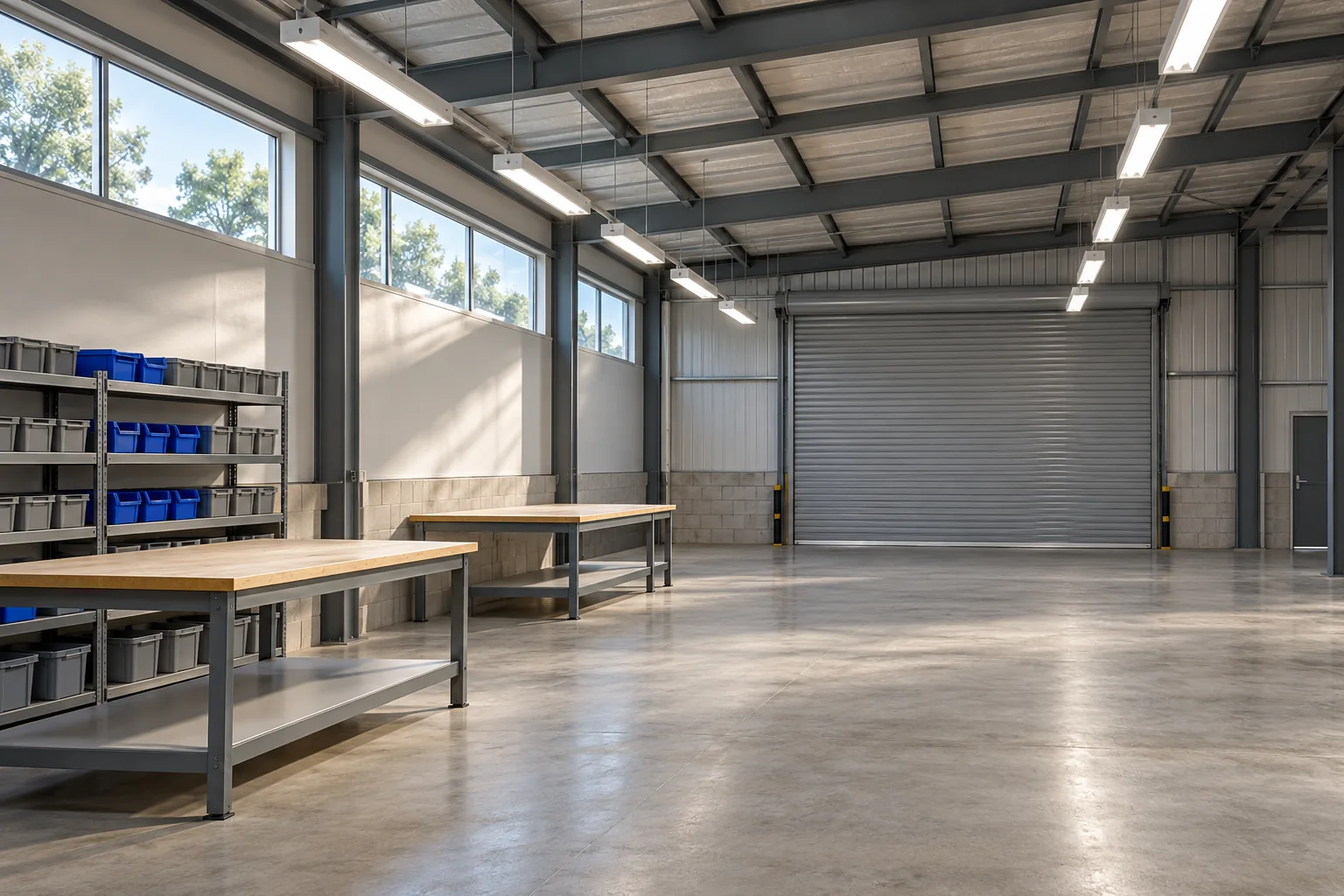
Describe what users should be able to do in each area, then ask how the proposed fixture and retained control arrangement will support it. Avoid a product shortlist that assumes the existing room choices will simply carry over. The exact equipment combination and its intended behaviour need confirmation before a selection is treated as final.
Keep local choices and wider coordination distinct. A meeting room may need understandable user selections, while a property team may have a different reason to discuss coordinated zones. State who operates the room, who approves changes and which records are expected. The comparison can then show what is included rather than hiding control decisions in an accessory description.
Four decisions connect inventory with procurement
-
Confirm the starting brief
Identify the areas, intended activity and record confidence. Separate present faults from replacement goals. Name the missing information that could change the option, and the contact responsible for confirming it before the equipment schedule is adopted.
-
Compare complete alternatives
Review retained parts, proposed products, controls and related work together. Keep the reason for each candidate visible. Ask which assumption makes one alternative different from another, so price discussions refer to a comparable facility boundary.
-
Agree workable phases
Connect each proposed phase with an area that can actually be released and returned to its intended use. Include adjacent retained lighting, access contacts and material routes. Record dependencies with fit-out work or tenancy decisions.
-
Resolve commitment and records
Confirm equipment variants, substitutions, approval responsibilities and any program sequence before ordering. Ask which installed-product and operating records belong in the handover. Keep later phases conditional where their scope or facility use is still unsettled.
A phase should have a useful operating boundary
Draw the first phase around a recognisable part of the operation rather than an arbitrary share of the fixture total. Identify the rooms or floor zones included, the users affected and the route that remains available. A phase needs its own completed purpose, even while the wider replacement decision continues.
Ask how delivery, staging and removed equipment will be coordinated with receiving, staff movement and neighbouring occupants. A planning area can hold the option records, but the facility contact must still confirm the actual available space and entry arrangements. Requested timing is a constraint to discuss, not an established work window.
Retain a phase register showing what was accepted, what remains and what changed during planning. When the next area is ready, revisit its current use instead of copying the first purchase automatically. A new tenant, altered stock pattern or revised room arrangement may change the unanswered question even when the visible ceiling looks similar.
Keep incentive timing beside the purchasing decision
Information reviewed: October 2, 2026. Reconfirm the official route for the actual proposed work before relying on a possible incentive.
Save on Energy Instant Discounts offers eligible existing-building lighting through participating distributors. Standard controls are included; networked controls follow the separate Retrofit route.
Retrofit requires application submission and participant-agreement acceptance before a binding commitment. Starting after submission but before pre-approval can reduce the incentive or result in rejection.
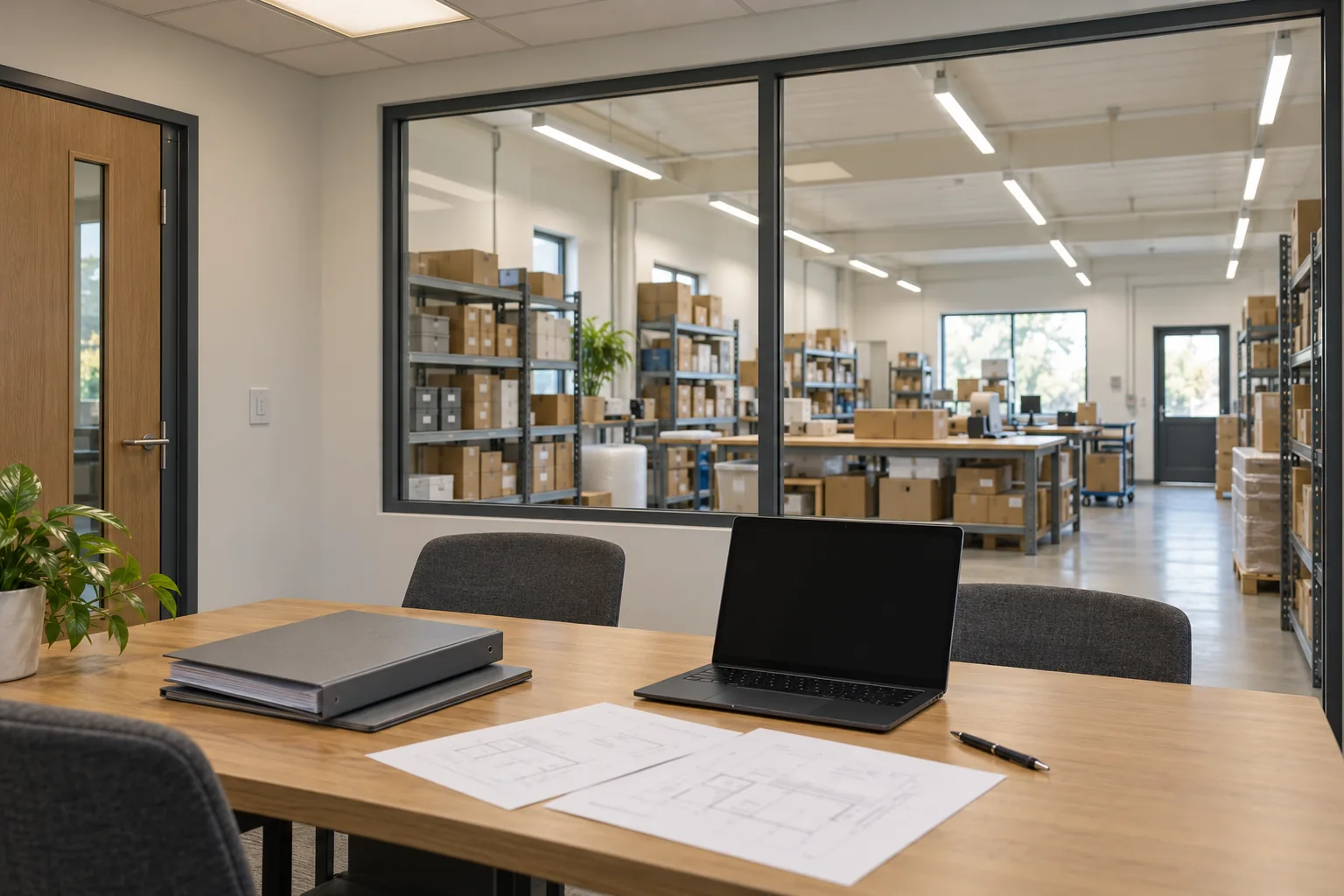
Give the purchasing contact a clear record of the selected option, the commitment status and the program question still open. Ask the relevant distributor or program representative to confirm the route and required sequence. Equipment suitability, business approval and possible program support are separate decisions that should remain visible together.